
This is a story of survival, unity, and quiet courage — written not by humans, but by giants of the African wild.

The morning began like any other on the open plains. The air was cool, the light soft, the land breathing slowly as the sun climbed higher. But beneath that calm, something extraordinary was about to unfold — something ancient, instinctive, and deeply moving.
A female elephant was giving birth.
She did not stand alone.
Around her, the herd closed in — not in panic, but with purpose. One by one, massive bodies moved into place, forming a living wall of muscle, tusk, and unwavering resolve. These were mothers, aunts, sisters, elders — each one stepping forward as if summoned by an unspoken vow: no harm will reach her today.
From a distance, wildlife photographer Paolo Torchio sensed the tension before he understood it. What he saw was not a casual gathering, not the loose social milling elephants are known for. This was different. This was tight. Focused. Charged with urgency.

Over the next hour, Paolo watched — barely breathing himself — as the drama unfolded.
The pregnant female stood at the center of the circle, her body heavy with the weight of a nearly two-year pregnancy. Elephant births are rare to witness, not because they are uncommon, but because the herd protects them fiercely. This moment — the most intimate and vulnerable event in an elephant’s life — is usually hidden from all eyes.
But this day, fate allowed a glimpse.
The surrounding elephants scraped the earth with their massive feet, tossing soil outward, creating a physical and symbolic barrier. They stood shoulder to shoulder, tusks aligned, eyes scanning the horizon. This formation, Paolo would later explain, is only seen in moments of extreme danger — predator attacks, or birth.
Lions. Hyenas. Opportunists drawn by scent and weakness.
The herd knew what was at stake.

Inside the circle, the mother labored. Her breaths came deep and heavy. She shifted her weight, leaning slightly against another female who moved closer, offering her body as support. No words passed between them — none were needed. This was knowledge older than language.
Time slowed.
Then, just after sunrise, it happened.
A new life slipped into the world.
At around 7:30 a.m., the stillness shattered with sound — trumpeting. Loud, raw, triumphant calls echoed across the plains, announcing the arrival of the newborn. It was not just a birth; it was a declaration: We survived. We protected. We prevailed.
But the work was not done.

Blood carries scent. Scent carries danger.
Immediately, the herd sprang into action. Soil and grass were thrown into the air, deliberately tossed over the birth site, covering every trace they could. It was a coordinated effort — practiced, precise, urgent. Each movement said the same thing: You will not be found. You will not be taken.
And there, on the ground, lay the calf.
Small. Wet. Fragile.

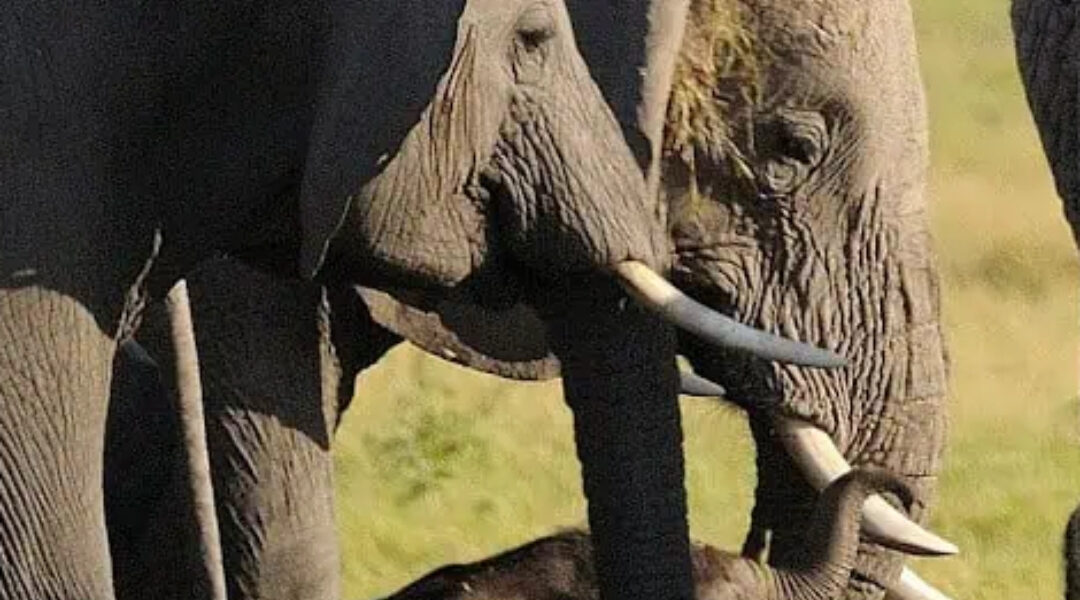
The baby elephant moved weakly, its legs trembling, unsure how to exist in gravity. At one point, the calf reached out with its tiny trunk and clutched an adult’s tusk — not as play, but as lifeline. It was the first act of trust, the first grasp at the world.
The adults responded instantly.
Gentle nudges. Steady pressure. Soft rumbles vibrating through their massive chests — sounds meant only for the newborn, sounds of reassurance and belonging. Again and again, they encouraged the calf to rise.
It tried.
It failed.
It tried again.
Minutes passed. Then more.

At 8:15 a.m. — nearly an hour after birth — the calf finally stood.
Wobbly. Unsteady. Alive.
The herd leaned in, forming a tighter circle, their bodies creating a sanctuary within a sanctuary. The calf found its mother, instinct guiding it to nourishment, and for the first time, it drank.
Milk. Warmth. Safety.
Paolo later described it as a shared victory — and it was. No single elephant could have protected that birth alone. It required the strength of many, the wisdom of experience, the willingness to stand between danger and life without hesitation.
This is what community looks like when stripped of ego and noise.

No hierarchy mattered in that moment. No age, no size, no individual importance. Only one truth remained: we survive together, or not at all.
In the wild, weakness is punished. Vulnerability invites loss. Yet here was a species that responded to vulnerability not by abandoning it, but by surrounding it.
By defending it.
By loving it.
The herd remained close long after the birth, moving only when the calf was strong enough to walk within their protection. Even then, the circle did not break — it simply moved, flowing forward like a living shield.

To witness such unity is to be reminded of something deeply human, something we often forget.
Survival is not just about strength.
It is about solidarity.
About standing close when it matters most.
On that morning in the African wild, a baby elephant took its first breath — not alone, but held by a family that refused to let the world take it too soon.
And in their quiet, powerful way, they showed us what it truly means to protect life.