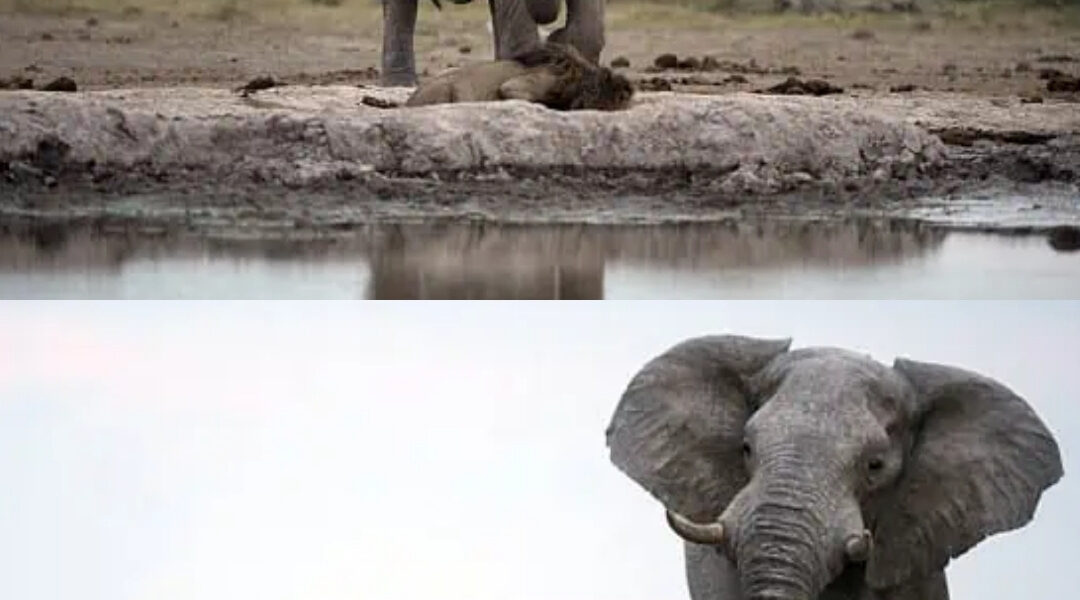

In the vast, shimmering heat of Botswana’s Nxai Pans, where the land stretches into a quiet haze and the world slows to the rhythm of breath and dust, danger often moves in silence. Predators stalk unseen. Herds drift like shadows. And sometimes, life and death hinge not on strength or speed, but on a single glance — a moment of instinct sharpened by the wild.
This is the story of a lion who almost lost everything… simply because he was thirsty.

As the sun dipped low, pouring gold across the plains, a lone male lion approached a watering hole. His mane, thick and dark, caught the last light of day like a burning halo. He had likely walked miles — tracking scents, patrolling the edges of his territory, surviving the relentless heat of the Kalahari.
Now, all he wanted was water.
He lowered his head, tongue rippling the surface of the pool, drinking deeply. Each gulp echoed softly in the stillness. No cubs to protect. No prides to challenge. No threats in sight.
Or so he believed.
Not far behind him, something enormous stirred.
Dust lifted. A deep rumble shivered through the ground — faint at first, then growing. But the lion, lost in the relief of cool water on a parched tongue, heard none of it.
He was alone. Vulnerable. And completely unaware that danger was closing in with unstoppable force.

Johan Bernard, a South African wildlife photographer, had his camera trained on the lion from a distance. At first, he saw nothing unusual — just a predator drinking at the end of a long day. But then a shape moved at the edge of the frame.
A bull elephant.
Massive. Silent. Approaching with long, purposeful strides toward the same watering hole.
Elephants rarely bother lions. But this bull had the determined posture of an animal unwilling to negotiate space. And in the open plains, size decides everything.
Still, the lion kept drinking.
Bernard later said, “He showed no vigilance at all. It was almost strange, how relaxed he was.”
The lion’s focus was fixed on the water. His ears were relaxed. His muscles loose. He didn’t sense the approach. He didn’t smell the shift in the air. He didn’t hear the heavy footfalls growing louder behind him.
The elephant closed the distance.
Ten meters.
Five.
Three.
The lion was seconds — seconds — from being trampled by thousands of pounds of living muscle and momentum.
The bus of tourists watching from afar held their breath. Bernard’s finger hovered over the camera shutter, torn between awe and dread.
And still, the lion drank.

Then, something — a faint tremor in the ground, a shift in the wind, a whisper of instinct — made him lift his head.
He looked up.
And froze.
Right behind him towered the bull elephant, ears out, trunk lifted in annoyance, a shadow swallowing the fading light.
For a heartbeat, neither animal moved.
Then instinct shattered the stillness.
The lion spun, paws kicking up sand, his body stretching into a full sprint. Adrenaline turned his escape into a blur of gold and dust. The elephant lunged, pounding the earth where the lion had just stood.
The ground shook with the impact.
Had the lion looked up even one second later, he would have been crushed beneath the weight of the elephant’s stride — bones broken, mane flattened into the dirt, a life ended in silence.
But fate, instinct, or simple wild luck intervened.
The lion escaped.
Just in time.

Bernard captured every frame — the calm, the looming danger, the frantic burst of survival. Later, he reflected on the near-tragedy:
“We watched the elephant get closer and closer. The lion didn’t react until the last possible moment. When he finally looked up… I think everyone watching held their breath. It could have ended right there.”
The photos, released to the world, stunned millions.
Not because they showed violence — but because they revealed how thin the line of survival can be, even for the king of the plains.
A lion is powerful, yes. Fearless, often. But even a lion is small beneath an elephant’s shadow.

The escape was a lesson carved into sand and instinct:
Even the strongest creatures are vulnerable.
Even the quietest moments can erupt into danger.
And sometimes, life depends not on muscle or speed, but on awareness — on lifting your head when something inside tells you to look.
After fleeing to safety, the lion slowed, turned once, and stared back toward the watering hole. The elephant was already drinking, unbothered, unconcerned, acting as though the entire encounter had been nothing more than a mild annoyance.
To the elephant, the lion had simply been in the way.
To the lion, the elephant had almost been his end.
But survival is what shapes these lands. And both animals walked away that evening carrying the same unspoken truth:
The wild does not grant second chances often…
But today, it did.

The sun disappeared. The plains slipped into the cool hush of night. Somewhere in the distance, hyenas began to cackle. Birds settled into the thorn trees. Life continued, as it always does.
But in the memory of everyone who witnessed the moment — in Bernard’s lens, in the breathless silence of the tourists, in the heart of the lion who nearly lost his life — the scene remained carved like stone:
A lion, head bent to drink.
A giant, storming from behind.
A moment of instinct.
A leap away from death.

It was a reminder — powerful, raw, unforgettable — that in the wilderness, fate can turn on the smallest movement.
And sometimes, survival is nothing more than the simple act of looking up.