The 14-Year-Old Girl Who Miraculously Survived 12 Hours at Sea After a Devastating Plane Crash.

“Daddy, I couldn’t see anything.”
Those were the first words fourteen-year-old Bahia Bakari whispered to her father after defying what should have been an impossible fate.
She was small, shy, soft-spoken — the kind of girl who avoided attention, who walked quietly beside her mother through airports, holding her boarding pass with both hands as if it might fall.
But before dawn on a Tuesday morning, she became the lone survivor of a plane crash that killed up to 152 people.
And she became something else too — living proof that a fragile body and a terrified heart can still hold on when the world breaks apart.

Bahia had boarded the Yemenia Airbus A310 with her mother, Aziza, just one day earlier.
The two had planned a simple summer trip to the Comoros.
A season of family visits, long meals, laughter, and the warm salt air of islands where her parents had been born.
They had left Paris in the soft light of morning.
They had taken the long path through Marseille, then Sana’a, transferring planes in Yemen for the final stretch toward Moroni.
Her mother was calm.
Bahia always followed her lead.
Little did either know that within hours, the sky itself would turn against them.

It was nearly 2 a.m. when the plane approached the Comoros through a wall of darkness and wind.
Passengers felt the shaking first — a jolt that rippled through the cabin like a warning no one wanted to interpret.
Outside, the ocean below was black, invisible, endless.
Inside, mothers whispered prayers.
Children slept.
Fathers tightened their seat belts.
And then came the violent drop.
The metal groan.
The scream of engines fighting the storm.
The cabin lights flickering as if the plane itself knew it was losing the battle.

Bahia remembered none of the technical details.
Only sensation.
Only chaos.
Only the moment when the world shattered like glass.
“I found myself in the water,” she later told her father in a trembling voice.
“We saw the plane fall… Daddy, I couldn’t see anything.”

When the aircraft struck the ocean, it broke apart in an explosion of water and steel.
Many passengers never even woke.
Many never even knew what hit them.
But somehow, whether by God’s will or pure instinct, Bahia was thrown clear of the cabin, hurled into the sea with force that should have killed her.
Instead, she surfaced gasping, choking on saltwater, blinded by darkness.
Bruises throbbed across her face.
Her collarbone burned with pain.
And still — she was alive.

The waves were merciless.
Every swell towered like a wall above her before crashing over her small, shaking body.
She couldn’t swim well.
She could barely move.
And yet she refused to let go of the single object she found beside her — a floating piece of debris from the plane.
“I grabbed on to something,” she told her father.
“But I don’t know what.”

At fourteen, she weighed scarcely more than a child.
She had never been alone in the ocean.
She had never imagined a night like this — drifting alone in black water, surrounded by screams that quickly faded into silence.
She could hear voices at first.
She could hear splashing.
Crying.
Calling.
And then nothing.
Just the wind and the waves and the steady, terrifying awareness that she was now the only one left fighting.
“I was hearing people speak,” she whispered.
“But I couldn’t see anyone.”

Hour after hour passed.
The sky remained dark.
Her fingers numbed.
Her teeth chattered so violently it hurt.
The salt water stung her cuts.
Her broken collarbone throbbed in a steady rhythm.
Twelve hours.
Twelve hours in the ocean.
Twelve hours waiting for a miracle.

By early afternoon, rescue workers scanning the waves spotted something small moving between the swells.
At first they thought it was debris.
Then a hand lifted weakly.
A head surfaced.
And they realized — impossibly — that it was a child.
Alive.
Barely.

When they threw a buoy toward her, the waves pushed it away.
Bahia was too weak to reach it.
Her arms shook each time she tried to lift them.
One rescuer, without hesitation, dived into the rough sea.
He swam hard, fighting the current, until he reached her.
He wrapped his arm around her narrow waist and pulled her toward the boat where others hauled both of them in.
She was shivering.
Barely conscious.
But alive.

They covered her in blankets.
They pressed warm sugar water to her lips.
Her eyes fluttered.
And yet she said almost nothing.
Shock held her silent in a way that went deeper than fear.

News of a lone survivor reached Paris before the plane carrying her even landed.
Her father, Kassim Bakari, waited at Le Bourget in a daze, not daring to believe it.
He had already imagined the worst.
He had imagined losing both his wife and his eldest daughter in one brutal night.
And then came the call.
“I asked her what happened,” he told reporters softly, “and she said: ‘Daddy… I couldn’t see anything.’”
It broke him.
And it saved him.

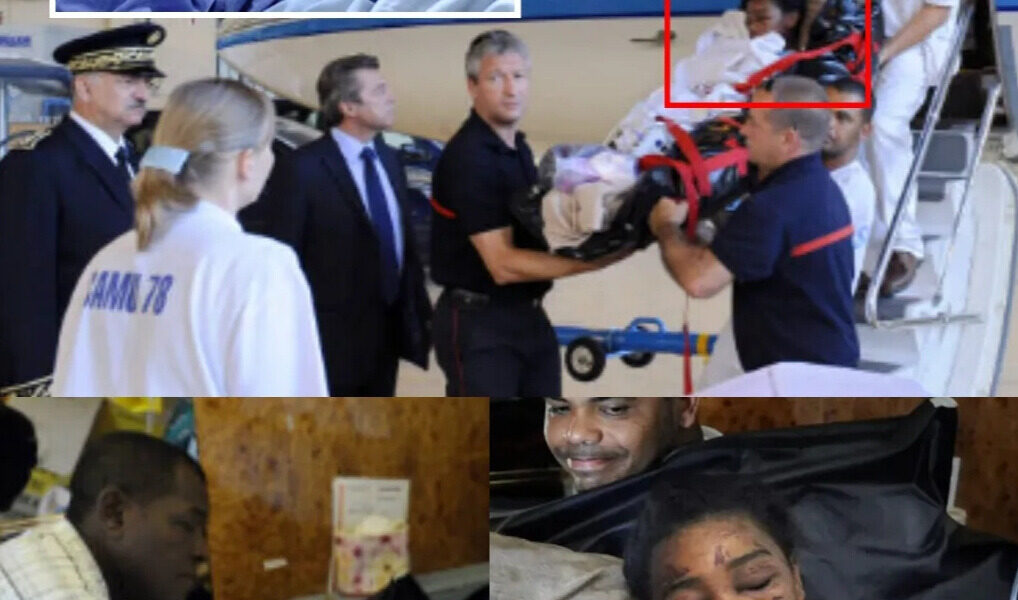
When she finally arrived, carried off the medical aircraft by paramedics, she looked impossibly small.
Her father rushed forward.
She clung to him with the last strength she had.
He wept into her hair.
“God kept her alive,” he whispered later.
“I can’t call it a miracle — only God’s will.”

But his relief was shadowed by another truth.
Aziza, Bahia’s mother, was gone.
Not missing.
Not injured.
Gone.
And Bahia did not know.
“They told her her mother was in the room next door,” Kassim admitted, voice trembling.
“So as not to traumatize her… but it’s not true.”
He stared down at his hands.
“I don’t know who is going to tell her.”

Officials and doctors spoke highly of the girl’s strength.
They called her brave.
They called her resilient.
Alain Joyandet, the French cooperation secretary, said she showed “incredible physical and moral strength.”
But Bahia did not feel strong.
She felt lost.
She felt hollow.
She felt like someone who had held on because holding on was the only thing she could do.

Outside the hospital, the world was reacting in anger and grief.
The crashed Yemenia plane, a 19-year-old Airbus A310, had long been criticized for safety issues.
Passengers transferring from France had been forced to leave a modern Airbus A330 and board the older aircraft in Yemen.
Many Comorans living in France were enraged, claiming the flights on the Sana’a–Moroni leg were often overcrowded, poorly maintained, and lacking in basic safety standards.
Their anger now had a face — the face of a fourteen-year-old girl who had survived what 152 others could not.

Meanwhile, French and U.S. aircraft scoured the ocean for bodies.
Families waited for news that would never be good.
And investigators searched desperately for the black boxes that might explain why the plane crashed after two failed landing attempts in high winds.
But for one family — for one father and the three children waiting at home — the focus was not on answers.
It was on the one fragile life that had returned to them.
A girl who floated alone in the dark for twelve unbearable hours.
A girl who survived through fear, pain, and instinct.
A girl who whispered into the phone:
“Daddy… I couldn’t swim very well.”
But she swam enough.
She held on enough.
And she lived.

Bahia Bakari became the sole survivor of the second-deadliest aviation disaster in history in which only one person lived.
Four years old.
Fourteen years old.
It didn’t matter.
Survival chooses without reason.
And on that night, in the black heart of the Indian Ocean, it chose her.

Not because she was strong.
Not because she was prepared.
But because, somehow, against everything fate had written, she refused to let go.
She refused to slip beneath the water.
She refused to give the ocean what it tried to take.
And she held on — for twelve hours — until help finally found the small, shaking shape of a child who should have drowned but did not.
Her father still remembers her voice.
Still hears the fear.
Still feels the miracle of it.
“She is a very shy girl,” he said quietly.
“I would never have thought she would survive like this.”
And yet she did.
And the world would never forget her name.