

Hank never thought of himself as anything special.
“My name’s Hank,” he liked to say. “I’m 66. I deliver propane.”
That was the truth of it. He drove the same rural routes every day — past frozen cornfields, old barns slumped by time, and farmhouses tucked so deep in the countryside that even cell service refused to follow. He filled tanks, checked connections, printed a slip, and moved on.
Most customers barely looked up. To them he was just the propane guy — a man in cold boots and a company jacket, someone whose name they never bothered to learn.
But last February, during the brutal cold snap, something changed.
The House With the Coats
He pulled up to the Miller place the way he always did, expecting a routine fill. But the gauge was sitting on empty. Not low. Not critical.
Empty.
And the air was biting — 15 degrees, the kind that burns your lungs when you breathe.
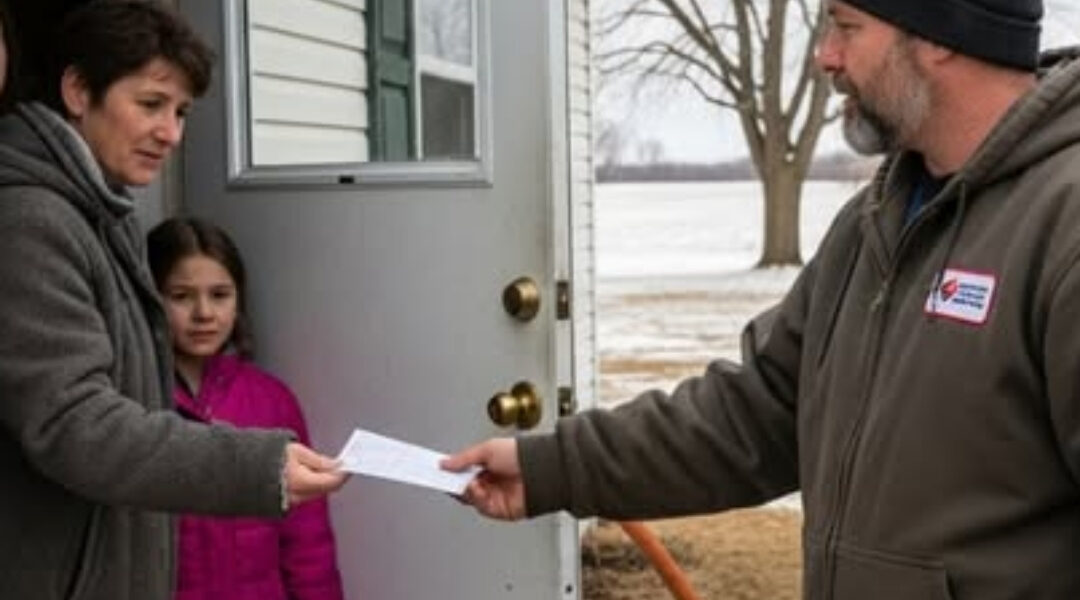
Hank knocked. After a long moment, Mrs. Miller opened the door, bundled in two sweaters, three little kids huddled behind her. And they were wearing coats.
Inside the house.
“Ma’am,” he said gently, “your tank’s bone dry. How long you been without heat?”
She swallowed, trying to keep her voice steady.
“Four days.”
Four days. Three children. Fifteen-degree weather.
He felt something inside him twist.
“We’re waiting on my husband’s paycheck,” she whispered. “Bill’s due Friday.”
Hank didn’t even let her finish.
“I’m filling it now,” he said.
“But I can’t pay until—”
“I’ll mark it as a delivery error. Computer glitch. Nobody’ll know.”
She froze. Tears filled her eyes before she could stop them.
“Why would you do this?”
Hank looked at the kids behind her — chapped lips, little hands rubbed together for warmth, homework spread across the table beside a flickering candle.
“Because those kids are wearing coats inside,” he said softly.
He filled the tank. Checked the furnace. Stayed until warm air finally flooded through the vents. And when he left, he sat in his truck for five minutes just staring at the steering wheel, heart aching in a way he hadn’t felt in years.
That night, he couldn’t shake the picture: a mother trying to look brave, and three children sleeping in jackets in their own home.
The Winter of Quiet Kindness
After that, Hank started seeing things differently.
The elderly veteran whose tank was at 10% — he was rationing heat, keeping only one room warm.
The single dad whose payment was two weeks late — he’d been burning scavenged firewood because his propane tank was near empty.
The widow who said she was “fine” — though her house felt like the inside of a refrigerator.
Hank began doing something he technically wasn’t supposed to.
When he saw someone struggling, someone empty, someone rationing heat just to survive the week, he added 50 gallons. Sometimes 75. Just enough to get them through the worst of it.
He’d write “meter calibration” or “pressure test residual” on the paperwork. Little lies. Small truths. Quiet mercy.
He did it eleven times that winter.
Until his boss called him in.
“Hank,” he said, tapping a stack of delivery slips, “we’re showing extra gallons delivered but not billed. Want to tell me why?”
Hank took a long breath and told him everything. Every family. Every cold house. Every coat worn indoors.
His boss didn’t interrupt. When Hank finished, he expected the worst.
But the man just sat there, eyes softening.
“My daughter was a single mom once,” he said quietly. “She chose between heat and groceries every winter. I wished someone had helped her.”
Then he made a decision that changed everything.
He didn’t fire Hank.
He created the Warm Hearts Emergency Fund — a pot for donations from customers, matched by the company, used for families in crisis who couldn’t afford heat.
Hank had never felt prouder.
The Envelope That Broke Him
Months later, in spring, when the air was warm and the fields finally thawed, Mrs. Miller walked into the office. She’d found a better job. Caught up on bills.
She pressed an envelope into Hank’s hands.
“For the next family,” she said. “The one you’ll find next winter — four days without heat, trying to be brave for their kids.”
Inside was $200.
Her voice trembled.
“My youngest has asthma,” she whispered. “Four more days in that cold… I don’t know if…”
She couldn’t finish.
Hank didn’t need her to.
That winter, the Warm Hearts Fund helped 23 families.
Not with charity.
With dignity.
With warmth.
And word spread. Other propane companies heard about it. Soon, emergency heat funds started popping up in six states. Thousands of homes warmed because one man refused to walk away from cold children in coats.
The Drawing That Finished the Job
The moment that finally shattered him came a month ago.
He got a delivery request for an address he knew by heart — the Miller place.
Mrs. Miller greeted him at the door with a bright smile.
“Hank! Come in!”
He stepped into warmth — real warmth. Kids laughing at the kitchen table. Homework sprawled under a shining lamp. Life. Safety. Comfort.
She handed him a check — full payment, plus extra for the fund.
“But there’s something else,” she said.
Her youngest appeared with a drawing.
A stick-figure man beside a propane truck.
Big smile.
Gray hair.
And in clumsy crayon letters:
“Mr. Hank — my hero.”
“She asks about you every winter,” Mrs. Miller said. “She wants to know if Mr. Hank is still making sure people are warm.”
Hank looked at the drawing for a long, trembling moment.
He was 66.
Just a propane delivery driver.
A man most people barely noticed.
But he had learned one truth — one he’d carry for the rest of his life:
Cold doesn’t wait for paychecks.
And no child should do homework in a winter coat inside their own home.
A Quiet Challenge to the World
“So if you deliver anything,” Hank said later, “oil, propane, firewood — and you see someone struggling…
Find a way.
Mark it wrong.
Call your boss.
Start a fund.
Do something.
Because heat isn’t a luxury.
It’s survival.
And the difference between freezing and living shouldn’t be whether your paycheck arrived on time.”
His story spread quietly, shared from one heart to another.
Because sometimes the greatest heroes aren’t the loud ones.
Sometimes they’re the men who deliver propane in the dead of winter…
…and choose kindness when no one is watching.