
Marcus always said Tuesdays were the quiet days.

Mondays were chaos — bills, packages, people running late for work. Fridays were loud — kids outside, dogs barking, neighbors chatting on porches. But Tuesdays? They were steady. Predictable. A perfect rhythm of footsteps, mailboxes, and greeting the same families he’d grown to care about over five years of walking this neighborhood.
That’s why the scream froze him.
It wasn’t a playful squeal from children chasing each other with water guns or a kid yelling about dropping an ice cream cone. This sound was sharp. Breaking. The kind of sound that comes from the stomach, not the throat.
Marcus stopped mid-step.
Before he could move, a little girl burst out of the house at the end of the driveway — hair wild, tiny legs running like they were carrying her away from fire. And then she was on him, slamming into his stomach with the force of someone desperate to survive.
“He’s breaking things!” she sobbed, gripping fistfuls of his uniform.
Chloe.
He knew her. Everyone did. The shy seven-year-old who drew him pictures to “mail back to the clouds,” convinced that’s where her letters went. The child who left him tiny bags of gummy bears in the mailbox because she thought mailmen “got hungry walking all day.”
Seeing her like this — shaking, crying, terrified — knocked the air out of him.
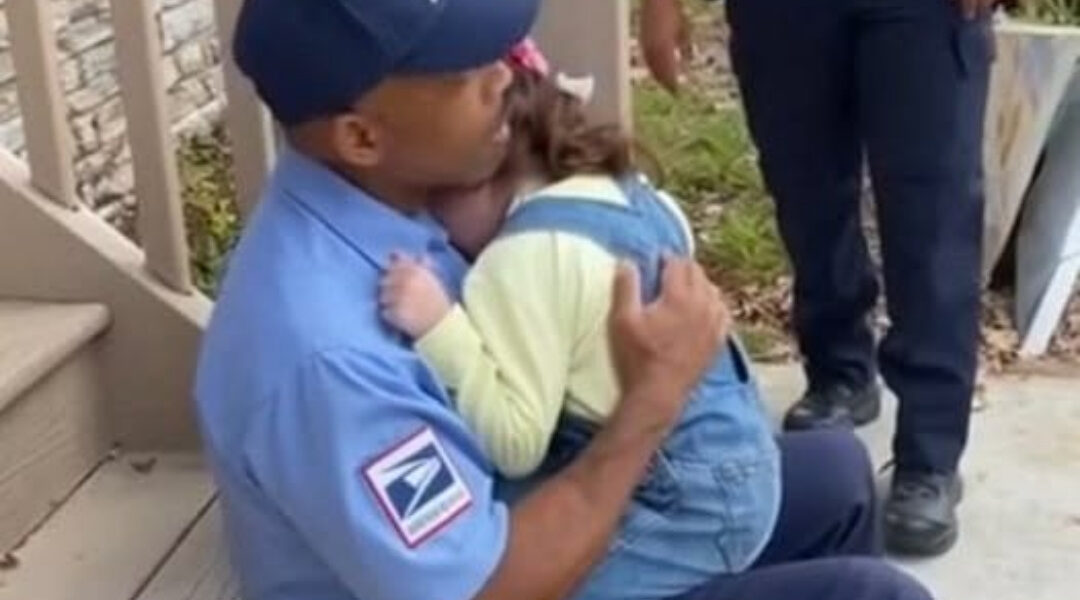
Marcus dropped his mailbag to the pavement and sank onto the steps with her, wrapping his arms around her small body. His hands were shaking, but he forced his voice to stay calm.
“Hey, hey… you’re okay. You’re safe now. I’ve got you.”
She pressed her wet face against his chest and clung like she was afraid he’d disappear if she loosened her grip. Her little fingers dug into the fabric of his shirt.
Inside the house, something crashed. Then another. A man’s roar rattled the walls.
Marcus held Chloe tighter.
He reached for his phone, but before he could even unlock it, sirens wailed in the distance. A neighbor — maybe Mrs. Alvarez across the street, maybe the Johnson boy who always played basketball outside — had already called for help.
Within seconds, two police cruisers skidded to a stop. Officers sprinted past him and into the house.
Marcus didn’t move.
He just kept his arms around Chloe, shielding her from sounds she never should’ve heard. Her small body jolted at every crash inside. So he started talking — quietly, softly, telling her about his own daughter’s favorite cartoons, about how he used to deliver mail in the rain and slip on someone’s porch and how she’d laugh if she heard the story. Anything to drown out the chaos happening behind them.
“Is your dad hurt?” he asked gently.
She shook her head violently. “He’s mad. He’s mad at Mommy. He threw the chair…”
Her breath hitched.
“…and he said it was my fault.”
Marcus felt something in him twist tight — anger, grief, helplessness. No child should ever believe their father’s violence was their fault. No child should ever run from their home barefoot in terror.
“It’s not your fault, sweetheart,” he whispered. “None of this is.”
Minutes later, officers emerged with Chloe’s father in handcuffs. His face was red, twisted with a fury he seemed to have lost control of. When he saw Marcus holding his daughter, he lunged forward, shouting her name.
Chloe screamed and buried her head deeper into Marcus’s chest.
That was the moment the officers realized: she wasn’t going anywhere except where she felt safe.
The officer closest to them approached slowly, voice gentle. “She alright?”
Marcus stroked Chloe’s trembling back. “She’s scared. Just… let her breathe a bit.”
The officer crouched to Chloe’s eye level. “Hey, sweetheart. Can you tell me what happened?”
But Chloe didn’t lift her head. Didn’t answer. Didn’t move.
She just curled tighter into Marcus, as though he were the only solid thing in a world full of splintering edges.
The officer nodded. “It’s okay. She can stay with you.”
As she walked inside to check on Chloe’s mother, the truth spilled out — truth that made the officer close her eyes in quiet heartbreak.
This wasn’t the first time.
Not the first fight.
Not the first broken object.
Not the first time Chloe hid in a bedroom corner while her father raged.
The mother had been too scared to tell anyone. Too scared to leave. Too scared to risk making things worse.
But today, the crash was loud.
Today, Chloe screamed louder.
Today, a neighbor heard.
And today, it all came undone.
Marcus didn’t know any of that. Not yet.
All he knew was that Chloe had gone completely still in his lap, exhausted and shaking, her breath hiccupping against his chest.
“I don’t wanna go back,” she whispered. “Please don’t make me.”
He tightened his arms around her.
“You don’t have to go back right now, honey,” he said softly. “You’re safe. I promise.”
The officers exchanged a glance — not the official kind, but the human kind. The kind that meant: Let her stay where she feels protected.
So they did.
For nearly an hour, Marcus sat there on the steps, his mail route forgotten, his bag still lying on the pavement, envelopes spilling out. Neighbors lingered on their porches, watching with quiet concern. Police lights flashed against the houses.
And in the middle of all of it, a mailman held a little girl like she was his own.
When Chloe finally looked up, her eyes were red and tired.
“Are you gonna stay until Mommy comes back?” she asked.
“I’m not going anywhere,” he whispered.
And he didn’t.
Marcus wasn’t a mailman anymore.
He was a harbor. The one steady, familiar, comforting presence in the middle of her storm. A stranger whose only duty that day was delivering mail — but who ended up delivering safety instead.
Some people become heroes by accident.
On that Tuesday, Marcus became hers.