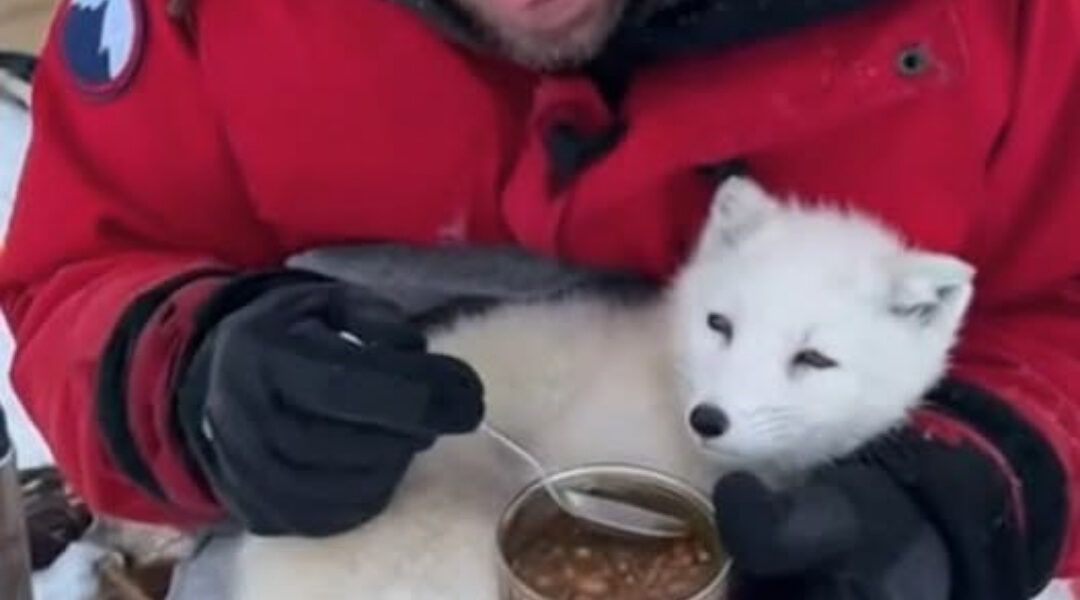

Dr. Aris Thorne wasn’t the kind of man who panicked.
He couldn’t afford to be — not in a place like this.

For six months out of every year, he lived alone on the ice, stationed at a remote Arctic research camp where storms swallowed entire landscapes and the nearest human presence was hundreds of miles away. His world was numbers, wind patterns, melting cycles, shifting permafrost, and long, echoing silence.
He liked it that way.
He liked the order, the predictability, the clean lines between human and wild.
And he lived by the first rule of his field:
Observe, measure, record — but never, ever interfere.
Nature is not a place for human hands.
Or so he believed.
The Flicker in the Snow
The day had been like any other. Aris had trekked out to check a weather sensor two kilometers from camp. The snow crunched in familiar rhythms under his boots, the wind cutting at his face like it always did. He was thinking about the data logs waiting for him, the calibration notes he needed to rewrite, the small routines that kept his isolated world in order.
Then he saw it.
A shape — tiny, white, barely noticeable — curled against the ice like a fragment of a snowdrift that didn’t belong.
He almost walked past it.
But something made him slow down.
He approached, squinting against the glare.
And then he saw the faint rise and fall of breath.
A tiny Arctic fox.
Juvenile.
Starving.
Its ribs formed a sharp, delicate cage under its fur. Its tail was pulled tight around its body, but it shook violently with every shiver. Frost clung to its whiskers. Its small paws were stiff with cold.
The fox opened its eyes for half a second — clouded, exhausted, barely conscious — before its head dropped again into the snow.
Aris knelt down.
His breath caught in his throat.
This wasn’t just weak.
This was dying.
The Rule Fighting the Heart
Every part of his training screamed the same thing:
Don’t interfere.
This is nature.
Let natural selection run its course.
He knew the speech by heart — the one he’d repeated to countless interns:
“If you intervene, you alter the population. If you rescue one fox, you take food from another. You shift the balance. You change the very ecosystem you’re trying to protect.”
He could almost hear his old professor in his ear:
“You are a scientist, not a savior.”
But Aris wasn’t listening to that voice anymore.
Not when this tiny creature, no bigger than his gloved hands, was shivering in front of him.
Not when its breath came in thin, broken pulses.
Not when the cold wind sliced across its fragile body like the world was already letting it go.
He stood there for a full minute.
Just stood there.
The wind howled. The snow stung his skin. Logic pushed one way; something older, softer, pulled the other.
Finally he whispered, “To hell with the rules.”
Breaking the Distance Between Man and Wild
He slid his arms under the fox’s tiny frame and lifted it gently.
It weighed almost nothing.
A small, frozen heartbeat pressed weakly against his chest as he wrapped it in his coat. He could feel the tremors — sharp, frantic shivers, the body fighting for its last chance at warmth.
Aris held the fox closer, shielding it from the wind with his own body as he trudged back toward the research tent.
Every step he took felt like a violation of the code he’d built his life around.
But every shiver against his chest reminded him why he kept going.
Back at camp, he placed the fox on a thermal blanket and switched on the small heater he usually used to dry gear. Warm air filled the tent, melting the frost from its fur.
Still, the fox barely moved.
Aris crouched beside it, studying the shallow rise and fall of its chest. He wasn’t a vet. He wasn’t trained for this. He wasn’t even sure what he was doing.
But he knew one thing:
He wasn’t letting this life slip away just because a rulebook said he should.
The First Sign of Hope
Aris opened one of his ration cans — thick, dense stew meant for long, freezing expeditions. It wasn’t ideal food for a fox. It wasn’t in any manual. But it was warm.
He scooped a bit of broth into a spoon and held it near the fox’s nose.
For a long moment, nothing happened.
Then —
A twitch.
A faint, trembling lift of the head.
The fox’s nostrils quivered. Its mouth opened slightly.
It tried to move toward the spoon.
Aris’ chest tightened.
“Easy,” he murmured. “Take your time.”
Slowly, painfully slowly, he guided the spoon to its lips. The fox swallowed the warm liquid, its small body shaking with effort.
Spoon by spoon, breath by breath, the fox began to respond — tiny movements, tiny sparks of life rekindling in the warmth of his hands.
Aris didn’t realize he was crying until a tear slid down his cheek and dropped onto the blanket.
This wasn’t data.
This wasn’t research.
This was something raw and human, something he hadn’t felt in years.
It was connection.
A Scientist With a Heart He Couldn’t Deny
Hours passed.
The fox rested, wrapped in blankets, fed in tiny spoonfuls, warmed by the steady presence of a man who had crossed the line he had promised himself he never would.
Aris sat beside it the entire time, resisting sleep, resisting any urge to step away. Every few minutes, he checked its breathing. Every hour, he fed it more broth. He spoke quietly — soft, steady words meant more to comfort than to be understood.
“You’re not alone anymore.”
“Stay with me.”
“You’re stronger than you look.”
The fox slept, its head tucked against Aris’ sleeve, breath no longer shaky but slow and steady — the rhythm of something coming back to life.
It would need days, maybe weeks, before it could return to the wild. And Aris knew what that meant — more rule-breaking, more interference, more choices that blurred the line between scientist and caretaker.
But as he watched the small creature rest, he felt something shift inside him.
Not regret.
Not fear.
A quiet certainty.
He had done the right thing.
Because sometimes the world is too harsh, the cold too unforgiving, and a rule written in a book can’t outweigh the truth written in the heart:
If you can save a life, you do.
Even at the end of the earth.
Even when no one is watching.
Even when it changes the way you see the world forever.