52 Years Old, Free at Last: The Elephant Who Touched the Ground Like He’d Never Known It Before.

For forty years, Thong Bai’s world was only a few steps wide.
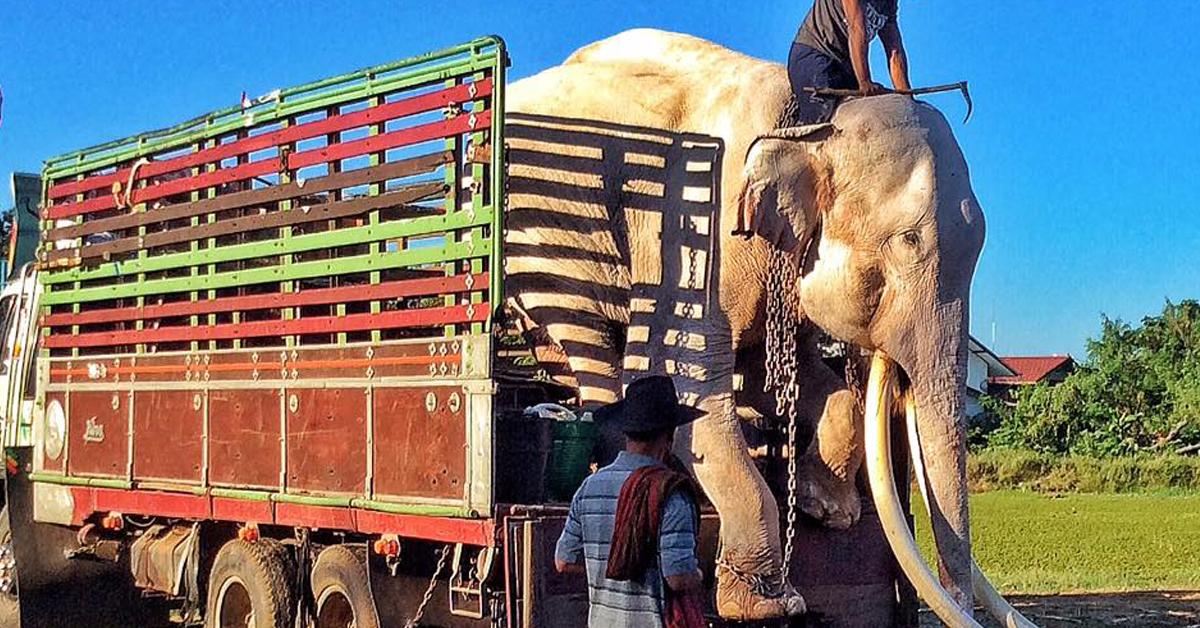
Chains wrapped around his front legs kept him tethered to a pole inside a cage, day after day, year after year. He could sway. He could shift his weight. But he could not walk freely. Not once. Not truly.
Thong Bai was born in Thailand more than half a century ago, strong and gentle, destined by nature to roam forests, form lifelong bonds, and communicate through low rumbles that travel miles through the earth. Instead, his life was decided by humans long before he could understand what freedom meant.
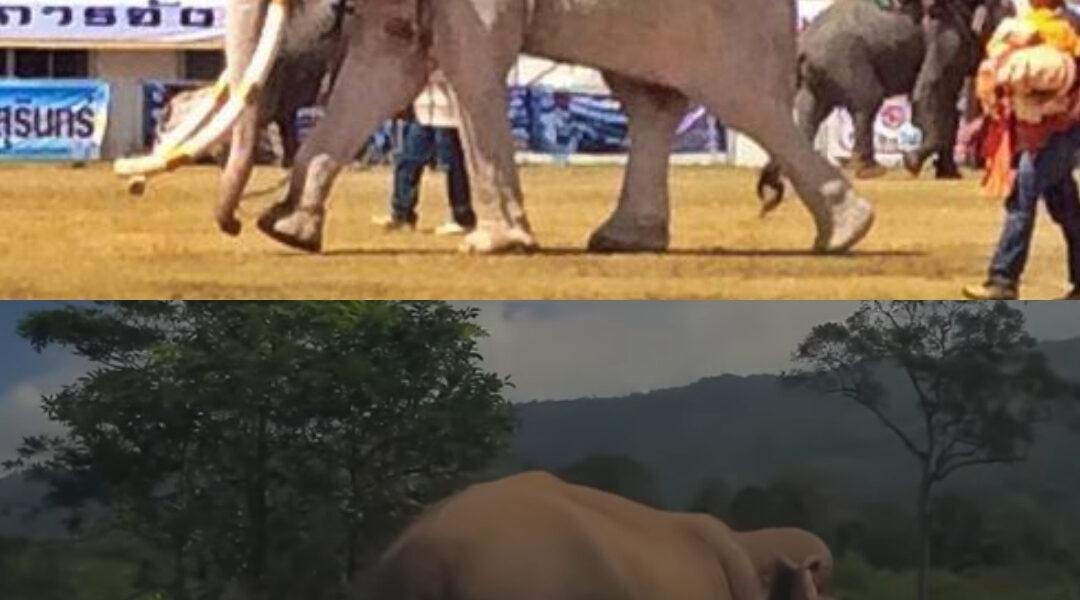
By the time he was young, Thong Bai had become a “celebrity elephant.”
He appeared at weddings.
He starred in advertisements.
He featured in films and tourist events.
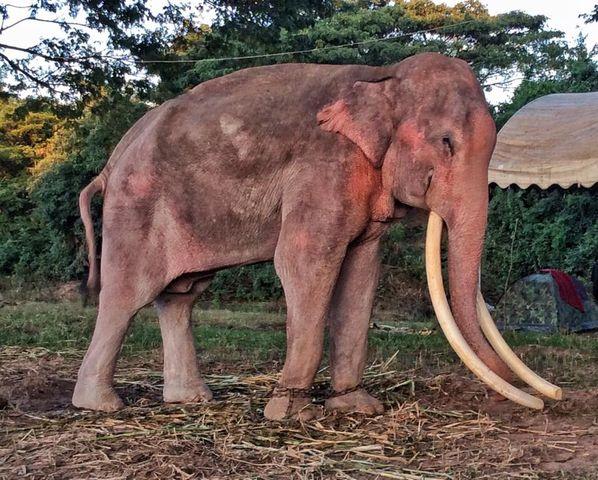
Crowds loved him. Cameras flashed. People smiled.
But behind the applause was a truth no one saw.
When the performances ended, Thong Bai returned to chains.
For nearly his entire life, his front legs were bound. The metal cut into his skin. His muscles weakened. His joints stiffened. The boredom and isolation carved wounds far deeper than the physical ones. Elephants are among the most intelligent and emotional animals on Earth. They mourn. They remember. They need family, space, and choice.
Thong Bai had none of those.
He stood alone.
Allowed to move only when he was paraded in front of crowds, Thong Bai learned to perform because survival depended on it. But every step he took was controlled. Every movement monitored. Every moment of stillness enforced.
Years blurred into decades.
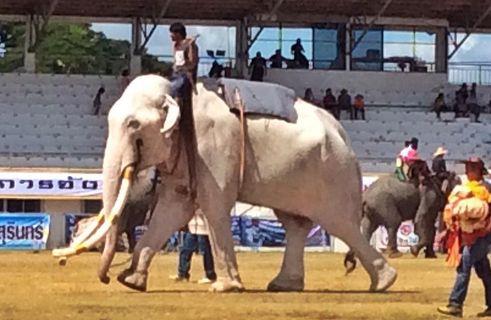
While the world changed around him, Thong Bai remained in the same place—aging, aching, waiting.
By the time animal welfare groups learned the full extent of his conditions, Thong Bai was 52 years old. Forty of those years had been spent in captivity. His body carried the toll: weakened muscles, damaged joints, scars from chains, and the slow, quiet exhaustion of an elephant who had never been allowed to simply be.
Rescuers knew time mattered.
When the team finally arrived, the moment was heavy with uncertainty. No one could predict how an elephant who had been restrained for so long would respond to freedom. Some captive elephants panic. Some freeze. Some don’t know how to move without restraints.
The chains were removed.
For a moment, Thong Bai did not move.
He stood still, his massive body trembling slightly, as if his mind was struggling to catch up with reality. The pole was no longer holding him. The metal no longer pressed into his skin. The weight he had carried for decades—gone.
Slowly, cautiously, Thong Bai lifted one foot.
Then another.
He stepped forward.
Observers held their breath.
His steps were awkward at first, careful and uncertain, like someone relearning how to walk. But with each movement, something changed. His head lifted. His ears relaxed. His trunk reached out, touching the ground, the air, the space around him.
Space.
For the first time in forty years, there were no chains to stop him.
Thong Bai was transported to a sanctuary, a place designed not for entertainment, but for healing. There were trees. Open land. Other elephants nearby. No crowds. No commands. No performances.
Just quiet.
Caretakers watched as Thong Bai explored his new environment. He walked slowly, stopping often, as if overwhelmed by the simple act of choice. He touched the ground with his trunk repeatedly, as if confirming it was real. That he was really allowed to be there.
They noticed his eyes.
They were brighter.
Softer.
Alive.
Recovery did not happen overnight. Decades of captivity leave lasting scars—physical and emotional. His muscles needed time to strengthen. His joints needed care. His mind needed reassurance that no one would punish him for resting, wandering, or stopping.
But day by day, Thong Bai adapted.
He began to roam more confidently. He interacted with other elephants, communicating in ways he had been denied for most of his life. He rested when he wanted. He bathed. He stood beneath trees and listened.
Caretakers described moments that felt almost sacred—Thong Bai standing quietly in the open, eyes half-closed, soaking in the world as if memorizing every sensation he had been denied.
For animal lovers, seeing Thong Bai’s first true steps into freedom was both joyful and heartbreaking. Joyful because he was finally safe. Heartbreaking because it took more than half a century to happen.
Thong Bai’s story is not just about one elephant.
It is about the countless animals still living in captivity, used for profit under the guise of tradition, culture, or entertainment. It is about how easily suffering can be hidden behind smiles and celebrations. And it is about what happens when compassion finally arrives.
Freedom did not erase Thong Bai’s past.
But it gave him a future.
At 52 years old, Thong Bai may never regain the years he lost. But what he has now matters just as much: dignity. Choice. Peace.
His story stands as proof that rescue is always worth it—no matter how late it comes. That healing can begin at any age. And that every living being deserves the chance to feel the earth beneath their feet without chains.
Thong Bai is no longer a performer.
He is no longer a possession.
He is an elephant—finally allowed to live like one.
And when he takes those slow, steady steps across the sanctuary, it feels like the world itself is watching… quietly promising never to forget.